
If you’ve been publishing blog posts and hoping they’ll somehow climb the search rankings on their own, you’re not alone. Many of us have tried the same. The successful attempts can be attributed to researching and creating content that addresses common search queries.
Most small business owners know content matters for SEO, but they’re not sure how to connect the two in a way that actually moves the needle in any direction!
That’s what this guide is for.
We’ll walk you through a practical content marketing SEO strategy you can start applying right now, whether you’re publishing your first post or cleaning up a blog that’s been running for years. By the end, you’ll know how to research topics, plan a roadmap, create content that ranks, and measure what’s working.
- What Is Content Marketing SEO?
- How Content Marketing Boosts SEO Performance
- Aligning Your Content With Search Intent
- Researching Topics & Keywords for Your Strategy
- Planning Your Content Marketing SEO Roadmap
- Creating SEO-Friendly Content That Ranks
- Using Multiple Content Formats to Reach More Searchers
- Earning Links & Authority With Guest Content
- Tracking SEO & Content Marketing Performance
- Implementing This Strategy on HostPapa Hosting
- Common Content Marketing SEO Mistakes to Avoid
What Is Content Marketing SEO?
Content marketing SEO is the practice of creating and sharing content that both serves your audience’s needs and earns rankings in search results. It brings together two disciplines that work best when they’re treated as one:
- Content marketing focuses on creating useful, relevant content that attracts and keeps an audience.
- SEO (Search Engine Optimization) focuses on ensuring that content is found through search engines like Google, Bing, and others.
When you separate the two, you end up with content that no one finds or rankings for pages that don’t actually help anyone. When you combine them, you create content that ranks, gets read, and turns visitors into customers.
Why Google Rewards Helpful, In-Depth Content in 2026
Google’s goal has always been to show the most useful result for any given search. In recent years, its algorithms have gotten much better at distinguishing content written for people from content written purely to game rankings.
Today, Google rewards content that demonstrates real experience, expertise, authoritativeness, and trustworthiness, which is known as E-E-A-T. For small businesses, that means publishing content that genuinely answers your customers’ questions, goes deeper than a surface-level overview, and reflects your actual knowledge of your industry.
How Content Marketing Boosts SEO Performance
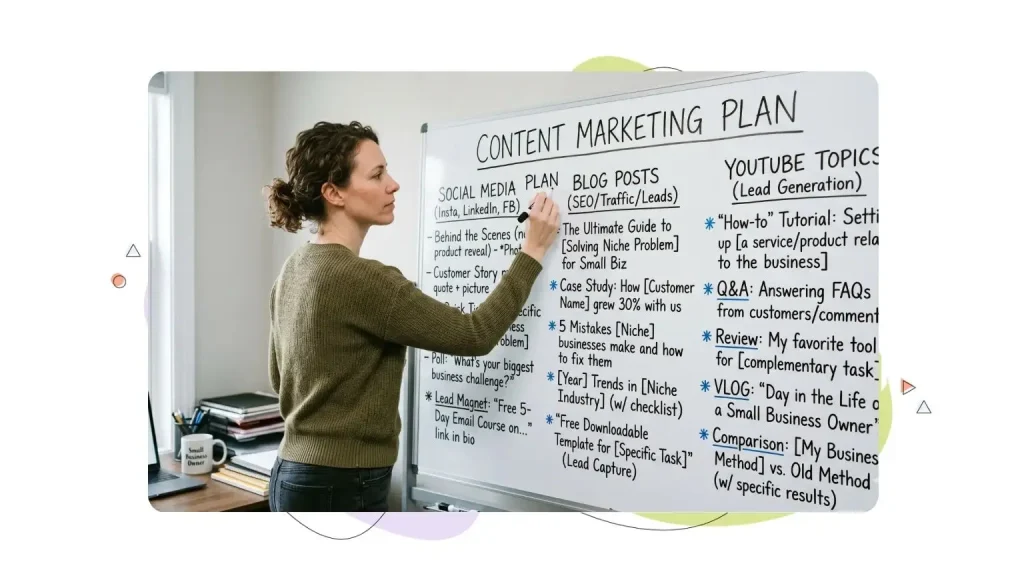
The Core SEO Signals Content Marketing Affects
Every piece of content you publish has the potential to influence how Google ranks your website. Here are the core signals it affects:
- Relevance: Well-written, topically focused content tells Google exactly what your site is about and which searches it should appear for.
- Backlinks: When other websites link to your content because it’s genuinely useful, Google treats those links as votes of confidence in your site’s authority.
- Engagement signals: If visitors spend time reading your content, click through to other pages, and don’t bounce immediately, Google interprets that as a sign your content is delivering value.
- Internal links: Connecting your posts and pages to each other helps Google crawl your site and understand how your content relates to your core products or services.
From Blog Posts to Backlinks: The Ranking Ripple Effect
A single, well-researched blog post can do more than just rank for one keyword. It can attract links from other sites, rank for dozens of related long-tail queries, bring in traffic that leads to email signups or sales, and give you content to repurpose across other formats.
That’s why the most effective content marketing strategies focus on building a body of interconnected content over time, not publishing individual posts and hoping for the best. Sustained organic growth comes from consistency, relevance, and quality working together.
Aligning Your Content With Search Intent
The 3 Main Intent Types (& Why They Matter for Your Content)
Before you write anything, you need to understand why someone is searching for a particular term. This is called search intent, and getting it right is one of the most important factors in whether your content ranks.
There are three main types:
| Intent Type | What the Searcher Wants | Example Query |
| Informational | To learn something | “What is content marketing SEO?” |
| Commercial Investigation | To compare options before deciding | “Best content marketing tools for small businesses” |
| Transactional | To take an action or make a purchase | “Buy WordPress Hosting plan“ |
Most “content marketing SEO” queries are informational or commercial. That means your content should educate first, with a natural path toward your products or services rather than a hard sell.
How to Read a Search Results Page to Match Format & Depth
You don’t need to guess what kind of content Google wants to rank for your target keyword. The search results page tells you directly.
Search your target keyword and look at the top-ranking pages:
- Are they long-form guides, short articles, or listicles?
- Do they use H2 and H3 subheadings throughout?
- Are there featured snippets with numbered steps or direct definitions?
- How in-depth are the explanations?
Match the format and depth of what’s already ranking, then aim to cover the topic more completely or from a fresher angle. For example, a query like “content marketing for SEO” calls for a practical guide with clear steps, not a landing page or a product description.
Researching Topics & Keywords for Your Strategy

Starting From Your Products & Services: Building a Topic List
The best place to start your keyword research isn’t a tool, but your own business. Think about:
- What do your customers ask you most often?
- What problems do your products or services solve?
- What does someone need to understand before they’re ready to buy from you?
From those answers, you can build a list of core topics. For a web hosting company, that might be: website speed, WordPress setup, SSL Certificates, eCommerce basics, and content marketing for SEO. Each of those topics becomes the seed of a keyword cluster.
How to Cluster Keywords & Prioritize What to Write First
A keyword cluster is a group of related search terms that all revolve around one central topic. Instead of writing a separate post for every variation of a keyword, you create one strong, comprehensive page that covers the topic thoroughly enough to rank for all of them.
Use tools like Google Keyword Planner, Google Search Console, or any keyword research tool to find related queries for each of your core topics. Then group them by:
- Search volume: how many people search for it per month
- Keyword difficulty: how competitive it is to rank for
- Business relevance: how closely it connects to what you sell
- SERP type: whether Google shows guides, product pages, or something else
Start with topics that are highly relevant to your business and where the difficulty is manageable. Quick wins early on build authority that makes harder keywords achievable later.
Avoiding Keyword Cannibalization With Evergreen Topic Pages
Keyword cannibalization happens when you publish multiple pages targeting the same or very similar keywords. Instead of one strong page ranking well, you end up with several weak ones competing against each other.
The fix: create one high-quality, evergreen page per topic cluster and keep it updated over time. Don’t publish near-duplicate posts on the same subject. When you have new information to add, update the existing page rather than creating a new one.
Planning Your Content Marketing SEO Roadmap
Turning Keyword Clusters Into Pillar Pages & Supporting Articles
A pillar page is a comprehensive page that covers a broad topic in depth. It’s supported by a cluster of shorter, more focused articles that each delve deeper into a specific subtopic, all linking back to the pillar.
For example, a pillar page on “web hosting for small businesses” might be supported by articles on WordPress setup, choosing a domain name, improving site speed, and SSL certificates. Each supporting article targets a more specific keyword and funnels readers back to the pillar.
This structure gives Google a clear picture of your topical authority and helps all the pages in the cluster rank better together than they would individually.
A Realistic Publishing Cadence for SMBs
You don’t need to publish daily to see results from content marketing SEO. For most small and medium-sized businesses, 2 to 4 well-researched pieces per month is a sustainable and effective cadence.
Consistency matters more than volume. One thorough, genuinely useful post per week will outperform five thin posts every time. Build a simple content calendar with:
- The topic and target keyword for each piece.
- The publish date.
- The pillar page it supports.
- The internal pages it should link to.
Internal Linking: Connecting Your Content to Your Conversion Pages
Every post you publish should link to at least one or two related pieces of content on your site, and at least one page that drives a business outcome, a product page, a sign-up form, or a contact page.
Internal links serve two purposes: they help Google crawl and understand your site structure, and they guide readers toward the next step you want them to take. Don’t wait until the end of a post to add links. Work them in naturally wherever they’re relevant to what you’re explaining.
Creating SEO-Friendly Content That Ranks
What “Quality Content” Actually Means for SEO in 2026
“Quality” isn’t just about good writing. For SEO purposes, quality content:
- Covers the topic completely, addressing the questions a reader is most likely to have, not only the surface-level ones.
- Demonstrates expertise through specific examples, clear explanations, and evidence of real-world knowledge.
- Is easy to navigate, with clear headings, short paragraphs, and a structure that lets readers find what they need quickly.
- Stays current, reflecting the latest practices and removing or updating anything that’s become outdated.
A useful test: after reading your content, does someone actually know more than they did before? Can they do something with what they learned? If yes, you’re on the right track.
On-Page SEO Checklist
Before you publish any piece of content, run through this checklist:
- H1: One clear title that includes your primary keyword.
- H2s: Section headers that reflect the subtopics readers are searching for.
- H3s: Sub-sections that break down complex points.
- Primary keyword: Used naturally in the H1, at least one H2, and within the first 100 words of the body.
- Secondary keywords: Woven into subheadings and body copy where they fit naturally.
- Internal links: At least 2–3 links to related content on your site.
- External links: 1–2 links to credible, relevant external sources where appropriate.
- Images: Descriptive alt text on every image.
- Meta title and description: Written to encourage clicks, not to include keywords.
- Mobile formatting: Short paragraphs, scannable structure, no walls of text.
Using Real Examples, Screenshots & Case Studies to Build E-E-A-T
Generic advice doesn’t build trust. What sets your content apart from every other guide on the same topic is evidence that you know what you’re talking about from experience.
Wherever possible:
- Use real examples from your industry or from your own customers’ experience
- Add screenshots when walking through a tool or process
- Reference specific outcomes rather than vague claims (for example, “refreshing this guide doubled our organic traffic over 90 days” is far more credible than “updating content improves rankings”)
If you don’t have your own data to cite, walk through a real scenario step by step. That practical specificity signals expertise to both readers and search engines.
Using Multiple Content Formats to Reach More Searchers

Matching Each Format to Its Search Opportunity
Different content formats appear in different parts of the search results page. Here’s how each format connects to a specific search opportunity:
| Format | Search Opportunity | Best For |
| Blog posts/guides | Web search results, featured snippets | Informational and commercial queries |
| Videos | Google Video results, YouTube search | How-to content, product walkthroughs |
| Infographics | Google Image search | Data-heavy topics, process summaries |
| Tools/calculators | Featured placements, direct searches | Transactional and commercial queries |
| FAQs / Q&A content | People Also Ask boxes | Conversational and question-based queries |
For most small businesses, starting with blog posts plus occasional videos covers the largest range of search opportunities without overextending your resources.
How to Repurpose Evergreen Content Across Formats
Repurposing is one of the most efficient things you can do in a content marketing strategy, which works for SEO, too. A single well-researched guide can become:
- A short explainer video summarizing the key steps
- An infographic distilling the main points visually
- A social post series pulling out individual tips
- An email newsletter edition built around one key section
The key is to repurpose with purpose, and not copy and paste. Each format should be adapted for the platform and audience consuming it, and each version should link back to the original piece to consolidate its SEO value.
Earning Links & Authority With Guest Content
The Modern Approach: Digital PR & Outreach
Backlinks are still one of the strongest ranking signals in SEO. The most effective way to earn them is to create content worth linking to, then make sure the right people know it exists.
Modern link building looks more like digital PR than cold outreach. That means:
- Creating original research, data, or perspectives that journalists and bloggers want to reference
- Pitching guest articles to publications your target audience actually reads
- Building relationships with complementary businesses in your industry who can feature or share your content
A link from one highly relevant, well-regarded website in your niche is worth more than dozens of links from unrelated or low-quality sources.
How to Find Link-Worthy Content in Your Niche
A practical way to identify what earns links in your space: search your target keyword and check which pages the top-ranking articles link to most. Those are the content types and angles that your industry already finds worth referencing.
From there, ask: Can you create something more complete, more current, or more useful than what already exists? That’s the basis for a content piece worth pitching.
Quality Over Quantity: Avoiding Link Schemes That Hurt SEO
Google’s guidelines are clear on link schemes. Buying links, participating in link exchange networks, or publishing thin guest posts solely for backlinks can result in manual penalties that can wipe out your search visibility.
Focus on relevance and genuine editorial value. Every link you earn should come from a context where it actually helps the reader, not just from a deal you made with another website.
Tracking SEO & Content Marketing Performance
Which GA4 & Google Search Console Reports to Check
Two free tools give you everything you need to measure your content’s performance: Google Analytics 4 (GA4) and Google Search Console (GSC).
In GA4, focus on:
- Organic traffic to individual posts over time
- Engagement rate (the percentage of sessions where users engaged meaningfully)
- Conversions attributed to organic traffic (sign-ups, purchases, contact form fills)
In Google Search Console, focus on:
- Queries: what people are actually searching to find your content
- Impressions and clicks: how often your pages appear and how often they get clicked
- Average position: where you rank for your target keywords
- Pages with high impressions but low CTR: these are candidates for a title and meta description refresh
The KPIs That Actually Matter
You don’t need to track everything. A focused KPI set is easier to act on:
- Organic sessions: total traffic from search engines to your blog
- Keyword rankings: position tracking for your target keywords
- Click-through rate (CTR): the percentage of impressions that result in a click
- Assisted conversions: how often content contributes to a conversion, even if it’s not the last touchpoint
- Backlinks to key content: new links earned by your most important pages
Review these monthly. If something isn’t moving in the right direction after three to six months, the post likely needs a refresh rather than abandonment.
Building a Content Audit & Refresh Cycle
Content doesn’t stay useful forever. Plan a quarterly audit where you review your top posts and check:
- Are the facts, tools, and examples still current?
- Has the keyword landscape shifted since you first published?
- Are there new subtopics or questions you could add to make the post more complete?
- Are there internal links to newer content you could add?
Updating a strong post is almost always faster and more effective than writing a new one from scratch on the same topic. It also signals to Google that your content is actively maintained, which supports rankings over time.
Implementing This Strategy on HostPapa Hosting

Setting Up Your WordPress Site for Content Publishing
WordPress powers a large portion of the web’s content for good reason. It’s flexible, well-supported, and built with content publishing in mind. When you host your WordPress site with HostPapa, you get Optimized WordPress Hosting and Managed WordPress Hosting options designed specifically for sites that need reliable performance as their content library grows.
Getting your content setup right from the start means:
- Installing an SEO plugin (Yoast SEO or Rank Math are widely used)
- Setting up clean, keyword-friendly URL structures (for example, /blog/content-marketing-seo/)
- Organizing content with categories and tags that match your topic clusters
- Enabling caching to keep page load times fast as your post count grows
How Site Speed, SSL & Uptime Directly Affect Content Performance
Your content can be excellent and still underperform in search if the technical foundation isn’t solid. Three factors matter most:
- Site speed: Google uses page experience signals as a ranking factor. Slow-loading pages frustrate visitors and increase bounce rates. HostPapa’s plans run on enterprise-grade NVMe storage, which delivers faster read/write speeds than traditional SSD hosting, a direct benefit for content-heavy sites.
- SSL certificate: Google flags sites without SSL as “Not Secure,” which damages both trust and rankings. Every HostPapa plan includes a free SSL certificate, active from the moment your site goes live. No setup required.
- Uptime: A piece of content can’t rank or convert if your site is down. Our 99.9% uptime guarantee means your content is always accessible when someone searches for it.
HostPapa Features That Support Consistent Content Publishing & SEO
Beyond the technical foundation, a few HostPapa features make the day-to-day work of content marketing easier:
- Global CDN: Your content loads fast for visitors around the world, not just those near your server location. This matters for international SEO and for readers who find your content from search results globally.
- Free white-glove website migration: If you’re moving an existing blog to HostPapa, our team handles the entire migration at no extra cost. Every post, image, and setting moves over intact.
- 24/7 PapaSquad support: When a technical issue threatens your publishing schedule or your site’s performance, our support team is available by phone, chat, or email, around the clock, every day of the year.
Common Content Marketing SEO Mistakes to Avoid

Keyword Stuffing & Chasing Volume Over Intent
Repeating a keyword phrase in every paragraph doesn’t improve rankings; it makes content harder to read and can trigger Google’s quality filters. Write for your reader first. If a keyword fits naturally, use it. If it doesn’t, don’t force it.
Equally, targeting high-volume keywords that don’t match your business or your audience’s intent is a common trap. A post that ranks for a keyword no one in your target market searches for doesn’t generate leads. Prioritize relevance over volume.
Publishing Thin Posts Instead of Consolidating & Updating Evergreen Pages
If you have several short posts on overlapping topics, they’re likely competing against each other in search results without any of them ranking well. The fix is to consolidate them: pick the strongest one, expand it into a thorough page, and redirect the others to it.
From that point, update the consolidated page when you have new information rather than publishing new thin posts on the same theme. One strong page consistently beats a cluster of weak ones.
Ignoring Internal Links & Technical Basics
A blog post that doesn’t link to anything else on your site is a dead end for both visitors and search engine crawlers. Every post should have at least a few internal links to related content and to relevant conversion pages.
On the technical side, broken links, missing alt text, slow page speed, and pages blocked from indexing can quietly undermine even your best content. A basic monthly check using Google Search Console catches most of these issues before they cause real damage.
FREQUENTLY ASKED QUESTIONS
How long until content marketing impacts SEO?
Most content takes 3 to 6 months to start showing meaningful ranking improvements, sometimes longer in competitive niches. This is normal. Search engines need time to crawl, index, and assess your content’s value relative to what’s already ranking. Consistency during this period matters; keep publishing and updating while the earlier work builds momentum.
Is blogging enough for SEO?
Blogging is one of the most effective tools for content marketing SEO, but it works best as part of a broader strategy. Blog posts alone won’t compensate for slow page speed, missing technical SEO basics, or no backlinks. Think of your blog as the engine of your content strategy, supported by good hosting performance, internal linking, and occasional link-building outreach.
How Long Should SEO Content Be?
There’s no universal answer, but longer, more in-depth content tends to rank better for informational and commercial queries. A practical guideline: your content should be long enough to cover the topic completely, and no longer. For most guides and how-to articles, that lands somewhere between 1,500 and 3,000 words. Use the top-ranking pages for your target keyword as a benchmark.
What’s the Difference Between Content Marketing & SEO?
SEO is the set of practices that help your site rank in search engines. Technical setup, keywords, backlinks, and page experience. Content marketing is the creation and distribution of useful content to attract and keep an audience. Content marketing SEO brings them together: you create content that genuinely helps your audience, structured and optimized so search engines can find it and rank it.
How Much Should a Small Business Invest in Content Marketing?
It depends more on time than money, especially at the start. A realistic starting point is dedicating time to publish 2 to 4 quality posts per month, supported by basic keyword research and a simple content calendar. As you see results, you can scale up the investment. The key is consistency. A modest but sustained effort almost always outperforms an intense burst of activity followed by months of silence.
Does social media count as SEO content marketing
Social media isn’t a direct SEO ranking factor for Google, but it’s a critical component of a holistic content marketing and SEO strategy, as it helps with distributing content to more people online. While social signals (likes, shares) don’t directly boost rankings, social media drives brand awareness, referral traffic, and quality backlinks, all of which indirectly improve SEO.
Start Building Your Content Strategy on a Solid Foundation
Content marketing SEO isn’t a shortcut to overnight rankings. It’s a compounding investment: the content you publish today keeps working for you for months and years to come, attracting visitors, earning links, and building authority that’s hard for competitors to replicate.
The foundation that content sits on matters just as much as the content itself. Fast page loads, reliable uptime, free SSL, and a hosting setup built for WordPress publishing are what turn a good content strategy into one that actually delivers results.
If you’re ready to build that foundation, explore HostPapa’s hosting plans and get your content marketing strategy running on infrastructure built for growth.
Explore HostPapa Hosting Plans: https://www.hostpapa.com