For years, a Virtual Private Server (VPS) was the middle option in hosting. It gave you more than shared hosting and cost less than a dedicated server. That’s no longer the whole story. Heading into 2027, VPS hosting is becoming the default starting point for growing websites, online stores, and the AI-Powered apps more businesses are building.
If you’re a business owner, an agency, or a developer deciding whether to upgrade your hosting before 2027, it pays to know where things are going. In this guide, we walk you through the VPS hosting trends 2027 will bring and what each one means for your site, your budget, and your team.
Here’s a quick look at the future of VPS hosting and the six trends we cover:
- AI-managed servers
- GPU-ready plans for AI workloads
- NVMe storage as the default
- Pricing shifts
- Data centre and edge expansion
- Security automation
We’ll also help you choose between managed and unmanaged VPS and pick a provider that’s ready for VPS hosting in 2027.
- Where VPS Hosting Stands Heading Into 2027
- AI-Managed VPS Hosting Becomes the Standard
- GPU-Ready VPS Plans for AI Workloads
- NVMe Storage & Performance-Tuned Hardware Are the New Baseline
- VPS Pricing in 2027: How Much Should Businesses Budget?
- Global Data Centre Expansion & Edge Computing Integration
- Security Automation Becomes Non-Negotiable
- Managed vs. Unmanaged VPS: Which Fits Your Business in 2027?
- How to Choose a VPS Hosting Provider Built for 2027
- Get Your Business Ready for VPS Hosting in 2027
Where VPS Hosting Stands Heading Into 2027
VPS hosting is one of the fastest-growing parts of the hosting market. Mordor Intelligence expects the global VPS market to grow from $5.99 billion USD in 2026 to $12.17 billion USD by 2031, a Compound Annual Growth Rate (CAGR) of about 15%. Other research firms land higher or lower, but most forecasts for VPS hosting market growth sit between 9% and 16% a year.
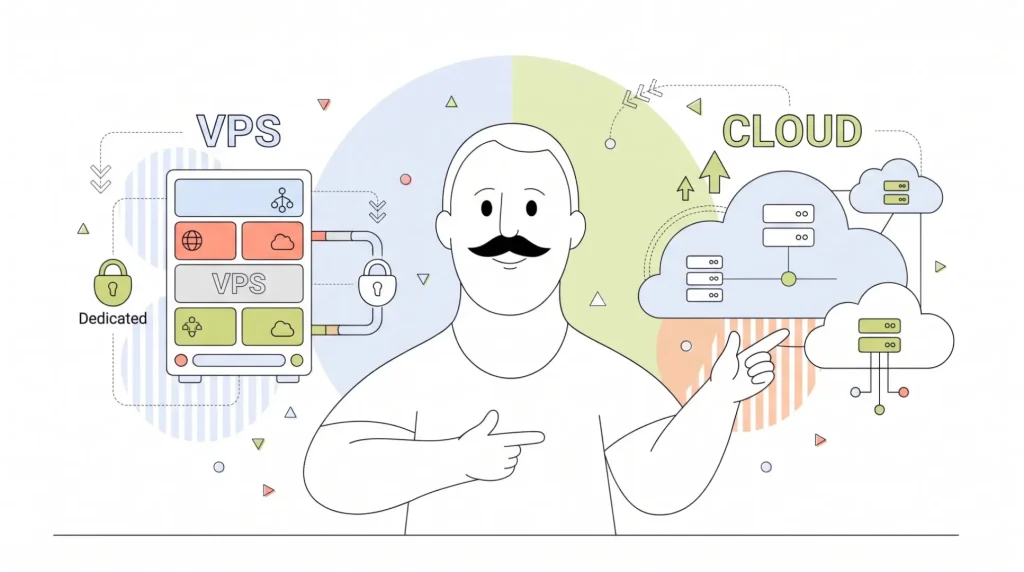
So, what’s a VPS? It splits one physical server into several isolated virtual servers. Each one gets its own guaranteed share of CPU, RAM, and storage, plus root access (full administrator control over the server).
When you compare VPS vs. shared hosting, the difference comes down to control and predictable performance. On a shared server, a busy neighbour can slow your site down. On a VPS, your resources are yours, and you can install the software your business needs. You get much of what a dedicated server offers without paying dedicated server prices.
Three forces will shape VPS hosting through 2027: AI, hardware, and pricing. Every trend below traces back to at least one of them.
AI-Managed VPS Hosting Becomes the Standard
AI-managed VPS hosting uses machine learning to watch your server around the clock, spot problems early, and adjust resources without anyone opening a terminal. Think of it as autopilot for server administration.
Here’s what AI VPS server management looks like on the platforms rolling it out in 2026 and 2027:
- Predictive scaling: The system studies your recent traffic, often the last 48 hours, and adds CPU or RAM before a spike hits instead of after your site slows down.
- Automated threat detection: The platform flags unusual activity and responds in minutes, so nobody has to dig through server logs first.
- Self-healing recovery: If a service crashes, the system restarts it or moves the workload on its own.
These features are still arriving unevenly. Some autonomous VPS hosting platforms automate a lot, while others put an AI-Powered label on basic monitoring. Over the next two to three years, we expect AI-assisted operations to become a baseline expectation, the same way NVMe storage and SSL certificates did.
You don’t have to wait for 2027 to hand off server chores. With HostPapa’s VPS Hosting, you can pick a Managed VPS option at checkout, and our PapaSquad team takes care of patching, monitoring, security updates, and control panel installs. Fully managed plans add a dedicated team of server admins and KernelCare for live kernel patching. You get a healthy, up-to-date server without learning a single Linux command.
GPU-Ready VPS Plans for AI Workloads
More small businesses are running their own AI tools, like customer service chatbots, product recommendation engines, and agents that sort emails or update inventory. To run AI models on a VPS, you often need more horsepower than a standard plan offers, especially when the model has to answer customers in real time.
Providers are responding with GPU VPS hosting. A Graphics Processing Unit (GPU) handles the type of math AI models rely on far faster than a regular CPU.
Hosting companies are adding GPU-equipped plans and pre-configured server images with AI tools like CUDA and PyTorch already installed. Developers can then launch an inference server (the part that runs a trained model and returns answers) without days of manual setup. Mordor Intelligence reports these ready-made images cut model deployment time from days to hours.
For a small business, this lowers the barrier to entry. You can test a chatbot or a recommendation engine on rented VPS for AI workloads instead of buying your own enterprise hardware.
Keep your expectations realistic, though. GPU capacity is still a specialty product with a price to match. Hetzner’s dedicated GPU server, for example, costs €889 per month. Most business websites won’t need a GPU in 2027. If your AI tools connect to an outside service, a standard VPS with enough RAM will do the job. GPU plans make sense once you want to run the model yourself.
NVMe Storage & Performance-Tuned Hardware Are the New Baseline
Non-Volatile Memory Express (NVMe) storage connects straight to a server’s processor through a high-speed PCIe connection. Older SATA SSDs use a connection first designed for spinning hard drives, which caps them at around 550 MB/s. Modern NVMe drives read and write data several times faster than that.
Heading into 2027, NVMe VPS hosting is the expected default, not a premium add-on. Here’s what that means for your site, even if you’re not technical:
- Pages load faster because the server pulls files and images off the drive sooner.
- Databases respond quicker, so product searches, checkouts, and logins don’t lag.
- Visitors stick around instead of bouncing while they wait.
Fast VPS storage isn’t a luxury anymore. Providers that still ship standard SSDs or hard drives on their default plans are becoming the exception. If you’re comparing plans for VPS performance in 2027, check the storage type first. It’s one of the easiest ways to spot outdated hardware.
Every HostPapa plan, including our VPS Hosting, runs on enterprise-grade NVMe storage and performance-tuned servers. Want the technical details? Read our guide to Why Storage Type Affects Site Speed.
VPS Pricing in 2027: How Much Should Businesses Budget?
VPS hosting pricing trends took a sharp turn in 2026. The rush to build AI data centres soaked up the world’s memory and storage chips, and server parts got a lot more expensive. Several European providers passed that cost on: Hetzner raised cloud server prices by 30% to 37% in April 2026, and OVHcloud raised its VPS range by 43% to 49%.
Can smarter technology bring prices back down? AI-Driven scheduling helps providers fit more work onto each server, which takes some pressure off. It can’t fix a chip shortage, though. Memory makers have warned shortages may last through 2027, and industry analysts don’t expect real supply relief before late 2027 or 2028.
So what should you plan for? Expect your VPS hosting cost in 2027 to hold steady or keep climbing, especially on plans with lots of RAM. Relief is more likely in 2028 than in 2027.
Here’s how to find affordable VPS hosting without nasty surprises:
- Compare renewal prices, not just the intro rate.
- Check what’s included, like control panel licences, backups, migration, and support.
- Ask if price changes apply to existing plans or only new orders.
- Lock in a longer term if you like the price you see today.
Global Data Centre Expansion & Edge Computing Integration
Edge computing means processing data closer to where your visitors are, instead of sending every request to one central server that may be thousands of kilometres away. Less distance means less latency, the delay between a click and a response.
VPS providers are opening new data centres and adding smaller network locations near 5G networks and regional hubs. Asia-Pacific is set to see the fastest VPS growth through 2031, with major cloud companies opening new zones in cities like Jakarta, Hyderabad, and Osaka. For you, more VPS data centre locations means you can host closer to your customers, which helps if you sell across borders.
You don’t need servers on every continent to benefit from edge computing VPS hosting, either. A Content Delivery Network (CDN) stores copies of your site’s images, scripts, and pages on servers around the world and serves each visitor from the closest one. Most HostPapa hosting plans include a built-in global CDN, so your site loads fast for visitors in Toronto, London, or Sydney. It’s one of the simplest ways to get the benefits of global VPS hosting without managing extra servers.
Security Automation Becomes Non-Negotiable
Attackers already use automation, so your defences need to move just as fast. That’s why VPS security automation is turning into a standard feature instead of an extra.
The biggest change is behavioural analysis. Older security tools compared traffic against a list of known threats. Newer AI VPS security tools learn what normal activity looks like on your server and flag anything unusual. That helps catch zero-day attacks (brand-new threats no rule list covers yet), and providers using these tools report fewer successful brute-force attacks, where bots guess passwords over and over.
Here’s what automated security looks like in practice:
- Continuous traffic monitoring, day and night.
- Automatic patching for the operating system and server software.
- Distributed Denial-of-Service (DDoS) mitigation that reacts in minutes, with no support ticket needed.
- Brute-force detection that blocks repeated failed logins.
A DDoS attack floods your server with fake traffic to knock it offline. Solid DDoS protection on a VPS in 2027 should kick in automatically, long before you notice a problem.
By 2027, manually watching server logs for threats will feel as outdated as installing an SSL certificate by hand. HostPapa VPS Hosting includes DDoS attack response, brute-force detection, network monitoring, and regular security updates, with SSL certificate support for your sites. It’s all backed by our 99.9% uptime guarantee.
Managed VPS vs. Unmanaged VPS: Which Fits Your Business in 2027?
With a managed VPS, your hosting provider handles setup, patching, monitoring, and troubleshooting. With an unmanaged VPS, you get full root control, but keeping the server updated and secure is your job.
Managed is where the market is heading. Managed plans made up about 68% of VPS revenue in 2025, and a 2026 CloudLinux survey found 29% of VPS providers now set themselves apart through fully managed service. Rising hardware costs have also narrowed the price gap between managed and unmanaged plans, which makes managed easier to justify.
Here’s how the two compare:
| Managed VPS | Unmanaged VPS | |
| Who handles updates & security | Your provider | You |
| Skills you need | Basic website know-how | Linux and command-line experience |
| Level of control | High, with guardrails | Full root control |
| Best for | Small businesses & first-time site owners | Agencies & developers |
Our simple rule: Choose managed VPS hosting for small business sites and first-time site owners without an in-house developer. Choose an unmanaged VPS if you’re an agency or developer who wants full control and is comfortable on the command line.
At HostPapa, you don’t have to pick one extreme. You can choose self-managed, managed, or fully managed support when you order. Compare our Managed VPS plans to find the level of help that fits your team.
What These Trends Mean for Your Business
The future of VPS hosting is faster, more automated, and easier to use. Here’s how to turn these trends into action.
If you’ve outgrown shared hosting, 2027 is a good time to move. Wondering when to upgrade to VPS? Watch for slow load times during busy periods, resource limit warnings from your host, or software your shared plan won’t let you install. Providers are building VPS hosting for growing businesses like yours, with faster hardware and more automation than ever.
If you’re testing AI tools, plan for them now. Chatbots and automation agents need extra RAM and CPU. Pick a plan with room to grow, or a provider that lets you upgrade without migrating, instead of retrofitting a basic plan later.
If you’re watching your budget, lock in what you can. Hardware costs are still shifting through 2027. If you find a plan you like, a longer term can protect you from future price increases.
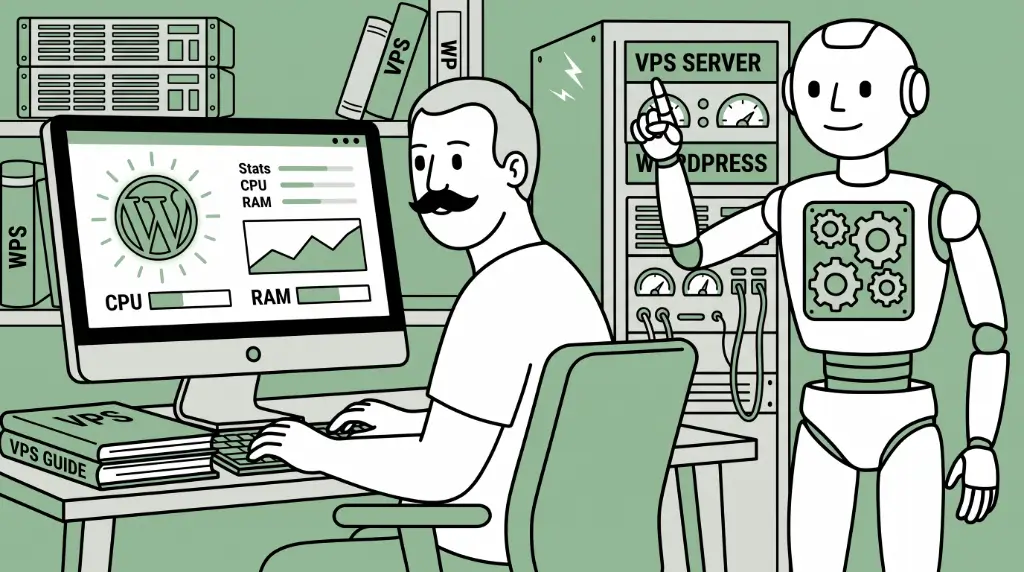
If you run WordPress, a VPS gives you breathing room. Busy blogs, heavy plugins, and WooCommerce stores all benefit from dedicated resources. Our guide to VPS hosting for WordPress walks you through it.
Most importantly, you don’t need to become a server administrator to benefit from any of this. Managed VPS and AI-assisted tools do the heavy lifting, so you can focus on running your business.
How to Choose a VPS Hosting Provider Built for 2027
The best VPS hosting for business isn’t always the cheapest plan on the page. Use this VPS provider checklist to compare your options:
- NVMe storage included by default.
- Transparent renewal pricing.
- Human support available 24/7 by phone, chat, and email.
- Free website migration from your current host.
- A clear uptime guarantee.
- A choice of management levels.
Also, watch out for vague AI-Powered claims. If a provider uses the label, ask three questions: What does it monitor? What does it fix on its own? When does a real person step in? A provider that can’t answer clearly is selling a buzzword.
Here’s how HostPapa VPS Hosting measures up:
- NVMe drives: Every plan runs on enterprise-grade NVMe storage and performance-tuned servers.
- Real human support: Our PapaSquad experts are available 24/7 by phone, chat, and email.
- FREE migration: Our migration experts move your site for you, with no downtime during the switch.
- 99.9% uptime guarantee: Your site stays online when customers come looking.
- Your choice of management: Pick self-managed, managed, or fully managed support.
Every plan is also backed by our 30-day money-back guarantee, so you can try it with zero risk.

Get Your Business Ready for VPS Hosting in 2027
The VPS hosting trends 2027 brings all point the same way. Servers are getting faster, smarter, and easier to manage, and they’re within reach of businesses that once thought a VPS was too technical. AI-assisted management, NVMe storage, and automated security are quickly becoming the baseline.
The businesses that upgrade to VPS hosting early will be the ones enjoying faster sites and more predictable costs while others play catch-up.
Ready to make the move? Get started with HostPapa VPS and choose the level of support that fits your team!
Explore HostPapa VPS Hosting Plans
Have questions about which plan is right for you? Our PapaSquad team is here 24/7 to help.