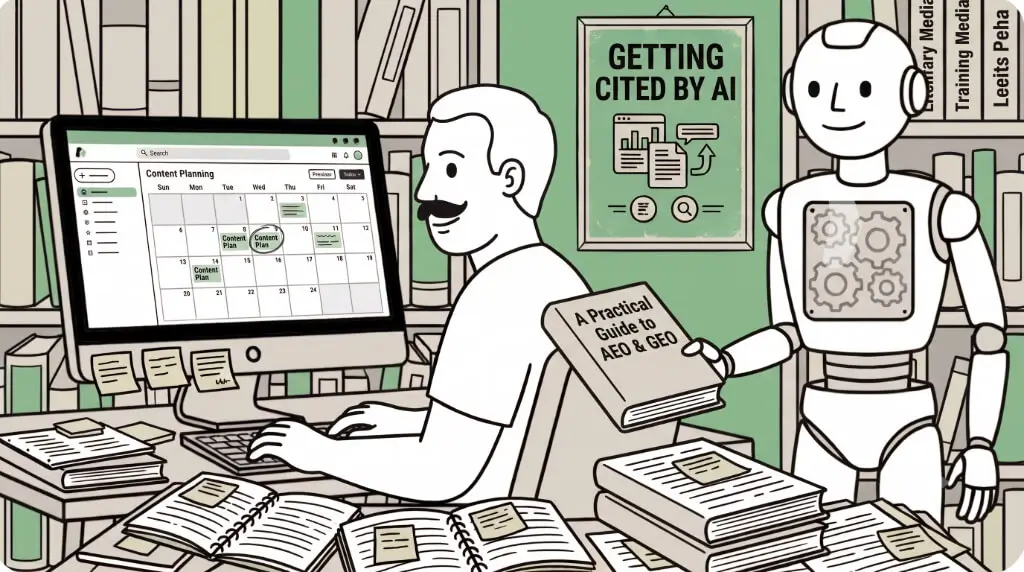
| Quick answer: To get cited by Artificial Intelligence (AI), publish clear and direct answers under question-based headings, identify each author and their relevant experience, and earn mentions on the third-party sites AI checks. Answer engines like ChatGPT, Perplexity, and Google AI Overviews verify a brand across several independent sources before they cite it, so your own site is only half the work. These practices are known as Answer Engine Optimization (AEO) and Generative Engine Optimization (GEO). |
For years, the goal was simply being found. You built a site, published pages, targeted keywords, and hoped to land on page one. That work still matters, but learning how to get cited by AI is what moves the needle now.
People don’t scroll ten blue links and pick for themselves the way they used to. They ask ChatGPT: “What’s the best project management tool for a small team?” Or they type a question into Google and read the AI-Generated summary before a single result loads.
The numbers back this up. In its analysis of real browsing data, Pew Research found that 18% of Google searches produced an AI summary, and that people clicked through to a traditional result in only 8% of visits where a summary appeared, against 15% where it didn’t. Fewer clicks reach your site, so being named inside the answer matters more than it used to.
So, the question has changed.
- It isn’t: “Can people find my website?”
- It’s: “When an AI builds an answer, why does it cite me?”
Don’t worry, there’s a clear path. We’ve built this guide around the six things that most reliably turn a brand into a source of AI quotes, and every section ends with something you can do this week.
CONTENTS TABLE
- What Does Getting Cited by AI Actually Mean?
- How Does AI Decide What to Cite?
- Why Does AI Cite Content With a Named Author?
- Can AI Crawlers Actually Read Your Site?
- How to Structure Content That AI Can Quote
- How to Get Mentioned on the Sites AI Reads
- How to Track if AI Is Citing You
- How to Turn an AI Citation Into a Customer
- The Tools Behind Your AI Visibility
- Your One-Week Plan to Get Cited by AI

What Does Getting Cited by AI Actually Mean?
Getting cited by AI means an answer engine names your brand, quotes your content, or links your page when it answers someone’s question. Think of it as the AI version of ranking. Instead of showing up in a list of options, you’re built into the answer itself.
Three acronyms describe this work and are worth 30 seconds of your time.
- Search Engine Optimization (SEO) gets your pages indexed and ranked so people can find them.
- Answer Engine Optimization (AEO) gets your content picked and cited when an AI answers a question.
- Generative Engine Optimization (GEO) is the bigger umbrella, covering everything you do to show up well across AI tools like ChatGPT, Copilot, Gemini, Google AI Overviews, and Perplexity.
These aren’t competing strategies. SEO makes you findable. AEO and GEO decide whether you get picked when a machine builds an answer. You need both.

How Does AI Decide What to Cite?
Answer engines build responses by finding information that appears relevant, clear, and trustworthy. Although each platform uses its own systems, four qualities can make your content easier to evaluate and cite:
- Verifiable authorship: Content written by a real, named person with relevant credentials is easier for a model to trust than anonymous text.
- Extractability: A clean, self-contained answer sitting right under a matching question is easy to quote. A great insight buried in the middle of a paragraph isn’t.
- Corroboration: Before an engine recommends a brand, it checks whether that brand shows up consistently in the places it already trusts.
- Freshness and evidence: Recently updated pages with real statistics, named sources, and expert quotes get pulled far more often than undated claims.
Everything below strengthens one of those four signals.

Why Does AI Cite Content With a Named Author?
Google judges content quality using E-E-A-T: Experience, Expertise, Authoritativeness, and Trustworthiness. It started as E-A-T. Google added the extra E for Experience because it wanted proof that content came from someone who’d actually done the thing, not just researched it.
AI search is wary of anonymous, machine-generated content, and for good reason: it’s now cheap to produce at scale. Google’s own Article markup guidance asks you to name every author of a page, and its helpful content guidance asks whether a reader can tell who wrote something and why they should trust them.
Answer engines read the same signals, so a page nobody will put their name to gives them very little to work with.
The takeaway is the same if you run a one-person shop or a 500-person company: Anonymous content underperforms.
Give every page a named, credentialed author: Sign your articles. Add a short bio with the author’s name, role, a credential or two, and links to an author page and LinkedIn profile. Keep the same name, photo, and title everywhere so the identity is easy to verify across the web.
Rewrite your About page as a story: Most About pages read like a press release written by nobody in particular. Yours should say why the business exists, how long you’ve done this work, who you serve, and what you believe. Name your certifications, years of experience, notable clients, and real results. It’s the richest source of experience signals you can hand an AI, and it’s the page cautious buyers read before they trust you.
Write from first-hand experience, in specifics:
Example A: “Many businesses struggle with cash flow” is the generic filler AI produces by the ton, and it earns you nothing.
Example B: “In eight years of doing books for freelance designers, the number one mistake we see is mixing personal and business accounts in month one” is experience. It’s quotable, it’s specific, and a competitor can’t copy it because they didn’t live it.
- Quick win this week: Add a signed author bio to your three most-viewed pages, then rewrite your About page with at least three real credentials.
Can AI Crawlers Actually Read Your Site?
None of the work below matters if AI crawlers can’t reach your pages in the first place. This is the step most guides skip, and it’s the one that quietly blocks a lot of sites from ever being cited.
Let the AI crawlers in: Your robots.txt file tells bots which parts of your site they’re allowed to visit. Check that you aren’t blocking GPTBot and OAI-SearchBot from OpenAI, PerplexityBot, ClaudeBot from Anthropic, or Google-Extended, which controls whether Google can use your content in AI answers. Plenty of sites blocked these bots a couple of years ago and never revisited the decision.
Make sure your content exists without JavaScript: Most AI crawlers don’t run JavaScript the way a browser does. If your main text only appears after a script loads, those crawlers see an empty page. View your page source, and if your copy isn’t in there, ask your developer about server-side rendering.
Get indexed in Bing, not just Google: ChatGPT leans on Bing’s index for a good share of its web results, so a site that’s invisible in Bing is invisible to many ChatGPT users. Submit your sitemap in Bing Webmaster Tools alongside Google Search Console.
Keep pages fast and available: Slow or unreliable pages can make crawling more difficult, and an engine won’t be able to cite something it can’t load. Reliable hosting and quick load times matter here just as much as they do for human visitors.
Consider an llms.txt file: This is a newer plain-text file you place at the root of your site to point AI tools at your most useful pages. No major engine requires it yet, and adoption is still early, but it takes minutes to add if you want to be ready.
- Quick win this week: Open yourdomain.com/robots.txt and confirm you aren’t blocking the AI crawlers you want citing you. Then view the page source on your top page and check that your main copy is actually there.
How to Structure Content That AI Can Quote
AI engines don’t read your page the way a person enjoying your writing does. They scan for clear, self-contained answers they can lift into a response. If your best insight sits in the middle of a long paragraph, it won’t get pulled. Placing it under a matching question makes it easier to extract.
This is the most mechanical part of the list, and one of the fastest to pay off.
Lead with the answer: For any page or section that answers a question, answer in the first sentence or two, then explain. Answer engines favour pages that answer up front and back it up underneath. Don’t make anyone, human or machine, dig for it.
Use question-based headings: Turn your headings into the questions people actually ask. Use:
- “How Much Does Professional Email Cost?” instead of “Pricing”.
- Use “How Do I Get Cited by AI?” instead of “AI and Marketing”.
These questions match the way people talk to ChatGPT and Google. Pew’s data backs this up: Searches beginning with a question word like who, what, when, or why produced an AI summary 60% of the time, against just 8% of one- and two-word searches.
Add an FAQ section, then mark it up: A real FAQ on your key pages is one of the most citation-friendly formats there is: a clean question, a clean answer, repeated. This is where schema markup earns its keep. Schema is code that tells search engines exactly what your content is. The types that matter most for AEO are FAQPage, HowTo, Article, Organization, and Author/Person. Most website platforms and SEO plugins can add it for you. AirOps’s 2026 State of AI Search found that pages using sequential headings and rich schema saw roughly 2.8 times higher citation rates.
Back your claims with evidence: The Princeton-led GEO study presented at KDD 2024 tested nine ways of rewriting a page and measured how visible each version became in generative answers. Adding quotations from credible sources worked best at about 41% above the unedited baseline, adding statistics gained about 31%, and citing sources gained about 27%. Keyword stuffing actually made pages less visible. So don’t just assert things. Quote an expert, cite a real number, and link a credible source.
Keep it fresh: Freshness is one of the few things you fully control, and it moves the needle. The same AirOps research found that about 83% of citations on commercial queries came from pages updated within the last year, and more than 60% from pages refreshed within six months. Put a last updated date on your cornerstone pages, then actually update them.
- Quick win this week: Pick your most important page. Rewrite the top so it answers the core question in the first two sentences, turn two headings into questions, and add a three-question FAQ at the bottom.

How to Get Mentioned on the Sites AI Reads
What you say about yourself matters far less than what the rest of the internet says about you. Before an answer engine recommends a brand, it cross-checks. It’s looking for you in the places it already trusts.
The data is striking. AirOps found that about 85% of brand mentions in AI answers come from third-party pages rather than a brand’s own website, and roughly 48% of citations come from community platforms like Reddit and YouTube. Your own site is a small slice of what an engine reads about you.
Claim the directories and review sites that fit your industry: Start with the general ones (Google Business Profile, Yelp, and Trustpilot), then add the ones specific to your field, like G2 and Capterra for software, Houzz for home services, or Clutch for agencies. Keep your name, address, and contact details consistent everywhere, and fill out every profile completely.
Earn mentions on sites AI already reads: This is old-fashioned digital PR with a new payoff: guest posts on respected industry blogs, spots in Best X for Y roundups, podcast appearances, and honest participation in relevant Reddit and Quora threads. Every credible mention is another data point telling the AI you’re real and recommended.
Be a source, not just a subject: Services like Help a B2B Writer and Featured connect journalists and bloggers with expert sources. Land a few placements and your named expert becomes a quoted authority on someone else’s trusted site, which reinforces the authorship signal from the last section.
Keep your identity consistent: Same brand name, same author names, same descriptions, same headshots. Consistency is what lets an AI connect the dots across a dozen sources and decide you’re one credible business rather than several fuzzy ones.
- Quick win this week: Claim or complete three off-site profiles, one general directory, one industry site, and one review platform. Then answer a relevant question in a public community thread under a real name.

How to Track if AI Is Citing You
You can’t improve what you can’t see, and most businesses have never asked an answer engine what it says about their category. Good news: fixing that is free and takes about 15 minutes.
Run the manual audit first: Open ChatGPT, Perplexity, and Google, and watch for the AI Overview at the top. Ask the questions your customers would ask. Skip “Tell me about my brand” and go for category questions like “Who’s the best bookkeeper for freelancers?” or “How do I choose a web host?” Write down what comes back. Are you mentioned? Are your competitors? Which sources is the AI citing, and could you be in them?
Then track it over time: AI answers change constantly, so a one-time check tells you little. An expanding group of tools now monitors brand visibility across ChatGPT, Copilot, Gemini, Google AI Overviews, and Perplexity, showing mentions, citations, sentiment, and share of voice against competitors. OtterlyAI starts around $29 per month and is aimed at smaller teams. Ahrefs Brand Radar, Frase, and Semrush bundle AI-Visibility tracking into their broader SEO toolkits. You don’t need the priciest option. You need a baseline you can watch move.
Watch the right metric: Don’t fixate on raw traffic, which gets less reliable as people take answers without clicking. Watch how often you’re mentioned and cited for your main category questions, and whether that share is climbing.
- Quick win this week: Run the manual audit on five category questions across ChatGPT, Google, and Perplexity. Save the results as your baseline, then re-run it monthly.
How to Turn an AI Citation Into a Customer
A citation gets you a visitor: Being remembered is what compounds. When AI hands people answers, and they click away, the brands that win are the ones that turn a moment of attention into a relationship.
Capture the email: Traffic you don’t capture is traffic you rent. Give visitors a reason to hand over an email address, like a template, a checklist, a short guide, or a scorecard. An email list is an audience you own, and it survives the next algorithm change.
Develop a consistent voice: People follow a recognizable point of view, not a logo. Pick a tone and a handful of things you genuinely believe about your industry, then say them consistently across your blog, your emails, and your social accounts. AI can generate endless generic content, but it can’t generate your perspective.
Give people a reason to come back: A regular newsletter, a running series, or a recurring format makes signing up feel like joining something. When you show up in someone’s inbox every week with something worth reading, you’re not competing for a search result anymore.
- Quick win this week: Put one email-capture offer on your highest-traffic page and draft the first send. Even a short monthly note beats no list at all.

The Tools Behind Your AI Visibility
None of this happens on its own. As you move from found to cited, the tools worth reinvesting in are the ones that make you look like the credible, established business an AI is deciding whether to recommend.
Professional email on your own domain comes first. Sending from a free consumer address undercuts every trust signal you just built, and an address like yourname@yourbrand.com costs very little to run.
Reliable Web Hosting comes next, because AI engines and search crawlers can’t cite pages that load slowly or drop offline. HostPapa’s 99.9% uptime guarantee and enterprise-grade Non-Volatile Memory Express (NVMe) storage keep your freshly updated pages fast and available, and our built-in global Content Delivery Network (CDN), included with most hosting plans, serves them from the location closest to each visitor.
Marketing tools round it out by making email capture and steady publishing actually happen instead of sitting on your someday list. If you get stuck along the way, our PapaSquad experts are on hand 24/7 by phone, chat, and email.

Your One-Week Plan to Get Cited by AI
You don’t have to do all of this at once. Here’s the order that gets you moving fastest.
- Today: Check your robots.txt file to confirm you aren’t blocking AI crawlers, then run the manual AI visibility audit on five category questions. That’s your baseline.
- This week: Add signed author bios to your top pages and rewrite your About page with real credentials.
- Next: Restructure your most important page to lead with the answer, use question headings, and add an FAQ with schema.
- Then: Claim three off-site profiles and land one credible outside mention.
- Ongoing: Add an email-capture offer, keep your voice consistent, and re-run your audit monthly.
The brands that get cited aren’t the ones with the biggest ad budgets. They’re the ones a machine can quote, and a person remembers. You can get there, and we’re happy to help you along the way.

Frequently Asked Questions
How do I get cited by AI?
Publish clear, self-contained answers under question-based headings, put a real credentialed author on every page, add FAQ and Article schema, and earn mentions on the third-party sites AI checks, like directories, review platforms, industry roundups, and communities such as Reddit and Quora. Answer engines verify a brand across several independent sources before citing it, so work on your own site is rarely enough.
What is Answer Engine Optimization (AEO)?
Answer engine optimization is the practice of setting up your content and online presence so AI answer engines like ChatGPT, Copilot, Gemini, Google AI Overviews, and Perplexity pick you and cite you when they generate answers. Traditional SEO gets you found in a list of links. AEO gets you quoted inside the answer.
What’s the difference between AEO, GEO, and SEO?
SEO gets your pages indexed and ranked. AEO gets your content picked and cited when an AI answers a question. GEO is the wider umbrella covering everything you do to perform well across generative AI tools. They work together, since SEO makes you findable and AEO and GEO make you citable.
Why isn’t my brand showing up in ChatGPT?
Often, for one of three reasons:
- There’s no named author or verifiable identity behind your content.
- Your answers are buried in long prose without question headings.
- You have a thin off-site footprint with few listings, reviews, or third-party mentions to check against.
Be sure to fix them in that order.
How long does it take to get cited by AI?
Changes to your own pages can affect citations within a few weeks, once those pages are recrawled. Off-site signals like directory profiles, reviews, mentions, and roundup listings often take a few months to add up. Three to six months is a realistic horizon.
Can you pay to get cited by AI?
Not directly. Citations in ChatGPT, Google AI Overviews, and Perplexity are earned through the underlying signals, not bought, though some platforms are testing separate ad placements alongside AI answers. If someone offers you guaranteed AI citations, they’re selling something else.
How do I show up in Google AI overviews?
Ranking well helps, but it isn’t the whole story. AirOps found that roughly 60% of AI Overview citations come from URLs that don’t rank in the top 20 organic results, so structure matters as much as position. Give a direct answer in the first sentence or two, use question-based headings, add an FAQ, mark it up with schema, and keep the page fresh.
What is E-E-A-T and why does it matter for AI citations?
Google’s quality guidelines use E-E-A-T, which stands for Experience, Expertise, Authoritativeness, and Trustworthiness. Google added the extra E to place more emphasis on first-hand experience.
E-E-A-T isn’t a single ranking factor or a universal formula for AI citations. However, the practices behind it can make your content and its authors easier to evaluate. A named author, relevant credentials, original examples, and clear sources give readers and answer engines more information they can use to understand why your content deserves attention.
How often should I update my AEO strategy?
Every few months at minimum. AI search moves fast, since models, tools, and citation behaviour shift month to month, so treat AEO as an ongoing habit rather than a one-time project. Re-run your visibility audit monthly and refresh your cornerstone pages twice a year.
Grab the free companion to this guide: the AI Visibility Audit scorecard, a fill-in template that captures what ChatGPT, Google, and Perplexity say about your business today so you can track it month over month.