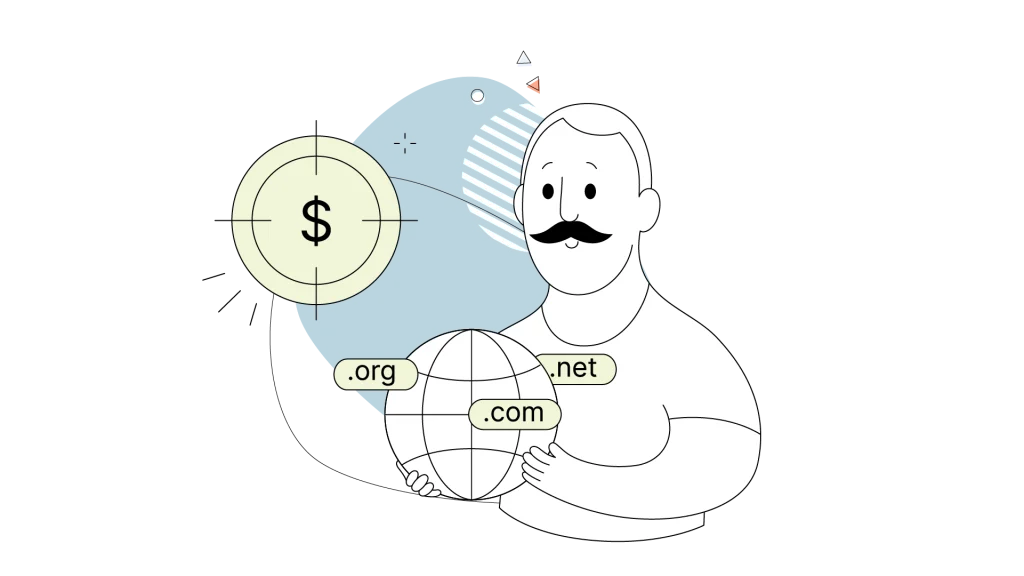
Every website address tells a story, and your domain extension is a big part of it. Think of your web address like a physical one. Your internet domain name is the house, while the domain extension, the part that comes after the dot, such as .com in hostpapa.com, is the street where your digital property lives. Together, they form your complete online identity. There are now nearly 1,600 top-level domains available for registration, with more being introduced regularly.
In technical terms, the domain extension (also known as a top-level domain, or TLD) helps categorize websites on the internet. Some TLDs like .com, .net, and .org are open to anyone. Others, such as country-code extensions like .ca or .uk, target specific locations, while specialized extensions like .shop or .law immediately signal what you do. The authoritative list of current TLDs in the root zone is published at the Internet Assigned Numbers Authority (IANA) website.
The .com domain extension is the most recognized and widely used, but many businesses are now adopting alternative TLDs for branding purposes.
Why does this matter for your business? Because your domain extension influences how people perceive your brand. It can boost trust, upgrade search relevance, and make your business name easier to remember. Choosing the right one isn’t just a technical step; it’s a strategic marketing decision that impacts visibility, credibility, and customer confidence.
When you register an internet domain, you do so through a domain registrar, a company that sells and manages domain name registrations. It’s important to choose an ICANN-accredited registrar, as this guarantees that your registration is handled by a provider that meets industry standards and is regulated to ensure trustworthy service.
The creation and management of new TLDs, reserved domains, and pseudo-domains are overseen by organizations like ICANN (which has authority over all TLDs used on the Internet) and the Internet Assigned Numbers Authority (IANA), ensuring the systematic development and stability of the domain name system.
- Domain Name System and DNS Hierarchy: The Technical Foundation
- Trending Domain Extensions in 2026: .ai, .io, and the Rise of New TLDs
- How to Choose Your Ideal Domain Extension: A Decision Framework
- Generic Top-Level Domain and SEO: What You Need to Know
- Avoiding Common Mistakes: Obscure TLDs, Hyphens, and Credibility Issues
- Domain Extension Costs: What You’ll Pay and Why Prices Vary
- Protecting Your Brand: Registering Multiple Domain Extensions
- Get Started: Selecting and Registering Your Domain With HostPapa
Domain Name System and DNS Hierarchy: The Technical Foundation
The Domain Name System (DNS) is what we use to navigate the internet every day. Instead of remembering a string of numbers for every website (that’s called an IP address), you simply type in a domain name, like example.com, and DNS takes care of everything else. We like to think of DNS as the internet’s phonebook, translating easy-to-remember names into the numerical addresses that computers use to find each other.
We’ve organized the DNS hierarchy in levels, with each part of a domain name separated by a dot. The last part, like .com in example.com, is what we call the Top-Level Domain (TLD). At the very top, we have the root zone, followed by TLDs, then second-level domains (like example), and sometimes third-level domains (like www or mail). This structure makes certain that every domain name is unique and points to the correct website.
The Internet Corporation for Assigned Names and Numbers (ICANN) oversees this entire system, making sure that assigned names and IP addresses don’t overlap. When you register a domain, you’re reserving a unique address in our global system, so users can always access your site without confusion. Understanding how the DNS hierarchy works helps you make informed decisions about domain name registration and management, making sure your business is always reachable online.
Understanding Domain Extension Categories
There are hundreds of TLDs available today, but they all fall into a few main categories. Understanding these helps narrow down your options quickly.
1. Generic TLDs (gTLDs): These are the classic, open-to-all extensions like .com, .net, .org, .info, and now hundreds of newer ones such as .blog or .app. They carry broad appeal and no location restrictions. .com remains king here, boasting roughly 159 million registrations worldwide, a staggering 42% market share of all domains.
2. Country-Code TLDs (ccTLDs): These two-letter extensions like .us, .ca, .uk, and .de signify national identity and are linked to specific countries or sovereign states. ccTLDs were originally assigned to represent individual countries or territories, and their intended geographic purpose still influences registration rules today. Some ccTLDs have restrictions that require the registrant to be a resident or entity within the country they represent, while others are open for anyone to register globally. For example, a bakery in Toronto may choose sweetbites.ca to connect better with Canadian customers. Internationalized ccTLDs are also available in native scripts, further supporting local identity.
3. Sponsored TLDs (sTLDs): Sponsored TLDs are managed by specific organizations with rules on who can register them. Examples include .edu (educational institutions), .gov (U.S. government), and .museum (museums). They immediately signal legitimacy within their category. Establishing ownership and verifying the original registrant is especially important for these domains due to their strict eligibility requirements.
4. Brand or Restricted TLDs: Large brands like Google (.google) and Amazon (.aws) now operate their own private TLDs. These are highly controlled, reinforcing brand authenticity but reserved for registered companies with global reach.
| Category | Examples | Who It’s Best For | Typical Restrictions |
| Generic (gTLD) | .com, .net, .org | Most businesses | None |
| Country-Code (ccTLD) | .us, .ca, .uk, .de | Local businesses, region-specific brands | Local presence requirement (varies) |
| Sponsored (sTLD) | .edu, .gov, .mil | Institutions, organizations | Strict eligibility |
| Brand/Restricted | .google, .bmw | Global enterprises | Internal use only |
Each exists for a strategic reason. Once you recognize their purpose, you can choose one or a few that fit your own audience and goals. When registering a domain, the original registrant holds primary ownership and management responsibilities, which is important for domain transfers and disputes. You can explore available alternatives directly using HostPapa’s domain search tool.
The .com Advantage: Why Businesses Still Choose It
There’s a reason .com remains the gold standard. It’s instantly recognizable, trusted, and globally accepted. When people hear a company name, they instinctively type .com first; it’s muscle memory at this point.
- Dominance: Over 159 million .com domains are registered globally, making it the most familiar and respected extension.
- Trust: Users often perceive .com sites as credible and established, important for conversions and click-throughs.
- Memorability: Customers remember .com domains more easily, reducing misspellings or confusion.
While Google’s Matt Cutts famously confirmed that all TLDs are treated equally in search rankings, perception still matters. People simply trust .com more. However, it’s not always the only (or best) option, especially when alternative TLDs align better with your message, industry, or availability.
Alternative to .com: When & Why to Choose .net, .org, and .co
When .com isn’t available, or when you want to emphasize something different, other extensions can offer specialty advantages.
(.net) The Tech Maven’s Choice
Originally meant for network businesses, .net evolved into a go-to solution for tech companies. Net TLDs are part of the DNS hierarchy and are managed by organizations like ICANN, with VeriSign overseeing the .net registry. Brands like SourceForge.net and Behance.net use it to project a digital, professional image. It’s ideal for infrastructure, hosting, or SaaS enterprises looking for a tech-savvy alternative to .com.
(.org) The Trust Badge for Nonprofits
Organizations, charities, and educational entities often lean toward .org for its association with community work and transparency. With over 10 million active registrations, .org communicates trust and purpose-driven values even before visitors read your homepage.
(.co) Short, Modern, Startup-Friendly
A global favorite for startups and entrepreneurs, .co feels sleek and punchy. It’s short for company and used by big players like Angel.co. Around 4 million .co domains are registered, driven by those who want an available, modern alternative to .com.
| Extension | Best For | Brand Perception |
| .net | Tech, IT, SaaS companies | Reliable, innovative |
| .org | Nonprofits, communities | Trustworthy, mission-led |
| .co | Startups, global entrepreneurs | Modern, agile |
These alternatives have distinct flavors; choose based on who you are and who you serve.
Note: Some newer or cheaper gTLDs, such as .xyz or .top, have been associated with spam, leading to user distrust. Additionally, extensions like .biz or .info have histories of being used by spammers, which can affect how users perceive your website’s credibility.
Industry-Specific Domain Extensions That Communicate Your Niche
New Generic Top-Level Domains (new gTLDs) are industry-specific or thematic extensions that amplify branding and offer businesses more ways to stand out online. Generic domains are safe, but industry-specific TLDs can sharpen your brand identity instantly. They make your website memorable and directly communicate what you do.
For example:
- .tech → tech startups, software engineers, or innovation brands.
- .shop → eCommerce and retail stores (specialized extensions like .io or .shop signal industry relevance).
- .law → attorneys or legal firms.
- .health → clinics, wellness brands, or health professionals.
Extensions like .studio or .pizza can define your brand’s purpose and potentially revamp Click-Through Rates (CTR).
This approach solves one of the biggest domain struggles: availability. Instead of competing for taken .com names, businesses can get shorter, clearer domain names under TLDs that mirror their industry.
According to the 2025 registration data:
- .tech → 679K.
- .shop → 3.2M.
- .store → 1.8M.
- .law → 30K (restricted).
Search engines don’t give these TLDs ranking boosts, but relevance helps SEO indirectly. For instance, miamifitness.shop immediately signals your business type and location, making it more clickable and user-friendly.
Geographic Domain Extensions: Building Local Trust With ccTLDs
If your target audience is localized, a country-code TLD (ccTLD) builds instant familiarity. Examples include:
- .ca (Canada).
- .uk (United Kingdom).
- .de (Germany).
- .au (Australia).
For instance, BrandName.fr immediately tells French customers that you cater to them. Google also recognizes this and boosts regional ccTLDs in local search results, strengthening SEO relevance.
Market data shows:
- .cn → 21M registrations.
- .de → 17.7M.
- .uk → 10.8M.
- .eu → 3.6M.
For businesses expanding internationally, local domain + local hosting (such as HostPapa’s 20+ global data centers) boosts site load speed and customer trust, critical factors in both usability and conversions.
Creating a Unique Domain Name: Stand Out From the Crowd
Choosing a unique domain name is one of the most important steps we’ll take in building our online presence. A memorable domain doesn’t just set us apart from competitors, it also makes it way easier for users to find and remember our website. Let’s start by brainstorming names that reflect our brand, are easy to spell, and simple to pronounce. We’ll want to avoid complicated words or unusual spellings that may confuse our visitors.
The choice of Top-Level Domain (TLD) also plays a big role in our success. While classic generic top-level domains like .com, .org, and .net are always strong resources, let’s not overlook newer gTLDs such as .io, .co, or .online. These can help us secure a shorter, more distinctive domain name that matches our business’s personality.
When we’re registering our domain, we’ll use a trusted registrar that offers WHOIS privacy protection. This service helps protect our personal information from being publicly visible in the domain registration database. It’s an extra layer of security for our business that we don’t want to skip.
Trending Domain Extensions in 2026: .ai, .io, and the Rise of New TLDs
New TLDs are booming in 2026. Let’s look at what’s shaping the future of domain identity:
(.ai) The Artificial Intelligence Star: Once reserved for Anguilla (.ai), this extension exploded as the tech industry adopted it for AI-related ventures. Over 600,000 registrations and counting, it’s now synonymous with innovation.
(.io) The Developer’s Darling: With 1.6 million active .io domains, this TLD remains the top pick for tech startups, signaling creativity and cutting-edge culture.
(.xyz) For Next-Gen Creatives: At 4.8 million registrations, .xyz gained traction thanks to its use by Google’s parent company, Alphabet (abc.xyz). It now represents originality and modern digital expression.
The bigger 2026 trend? Domain choices are less about exact keywords and more about brand personality. Short, unique names outperform keyword-stuffed domains. However, be cautious with very new or obscure TLDs; lower familiarity can sometimes raise spam concerns.
You can track the status of new domain extensions through certain platforms, making it easy to monitor upcoming TLD releases and their availability.
Top Level Domains and Website Accessibility: Ensuring Everyone Can Reach You
Your choice of Top-Level Domain (TLD) can make a real difference in how easily users can access your website. We’d recommend going with TLDs like .com, .org, and .net; they’re recognized worldwide and help your site appeal to a broad audience. If you’re targeting a specific country or region, consider country code TLDs (ccTLDs) such as .us, .uk, or .au. They signal local relevance and can boost trust with regional users.
When you select a TLD that matches your audience and content, you make your website more accessible and memorable. We’ve found that a simple, easy-to-spell domain name paired with a familiar TLD helps users reach your site without confusion. Don’t forget about configuring your Domain Name System (DNS) settings correctly; it’s paramount for making sure your website’s accessible from different locations and devices, so you’ll never miss out on potential visitors.
How to Choose Your Ideal Domain Extension: A Decision Framework
Feeling overwhelmed by possibilities? Here’s a simple decision framework based on five relevant criteria:
- Target Audience:
Are you local, national, or global? Use .ca for Canadian focus, .com for global reach. - Brand Identity:
Does your domain strengthen (not confuse) your brand voice?
Example: BrightBrew.coffee fits a café better than BrightBrew.xyz. - SEO Implications:
While Google doesn’t prefer .com over .io, users may. Choose based on relevance and clarity, not myths. - Scalability:
If you plan to expand internationally, a .com may give you room to grow beyond your current region. - Cost:
Balance budget and impact, premium TLDs may look appealing, but can inflate costs unnecessarily.
| Industry | Recommended Extensions |
| eCommerce | .shop, .store, .com |
| Tech/SaaS | .io, .ai, .dev |
| Professional Services | .com, .pro |
| Nonprofits | .org |
Generic Top-Level Domain and SEO: What You Need to Know
When you’re thinking about Search Engine Optimization (SEO), we want you to know that your choice of generic top-level domain can influence how users see your website. It doesn’t directly affect your Google ranking, but here’s what we’ve found: a .com domain name often feels more established and trustworthy to users, and that’ll lead to higher click-through rates. Don’t worry, though! Newer gTLDs like .online or .store can also be powerful if they’re relevant and memorable.
We’re here to tell you that the most important factor for SEO is the quality of your website’s content, structure, and meta tags, not just the TLD. But here’s the thing: a well-chosen gTLD can make your domain name stand out in search results and attract the right audience. We offer SEO tools and services at HostPapa to help you perfect your site and boost visibility, because we’re all about giving you the solutions you need.
Avoiding Common Mistakes: Obscure TLDs, Hyphens, and Credibility Issues
It’s easy to get creative; sometimes too creative. Avoid these common pitfalls:
- Overly obscure domains: Extensions like .ninja, .fun, or .space may sound quirky, but can undermine trust.
- Hyphenated domains: Harder to say out loud and often linked with spammy sites (confirmed by Google’s John Mueller).
- Trend chasing: Don’t choose a TLD just because it’s hot. Trends fade; brand clarity lasts.
However, exceptions exist. For a boutique coffee shop, JoesBrews.coffee is on-brand and appealing. The key is context; if your audience will recognize and trust the TLD, go for it. Otherwise, play it safe with standard or industry-specific choices.
Voice Search & AI Compatibility: The 2026 Domain Selection Factor
With smart assistants and AI-Driven voice interfaces dominating online interactions, voice-friendly domains are the new SEO frontier. Short, clear, and easy-to-pronounce names perform better in this era.
Best practices:
- Keep it under 12 characters if possible.
- Avoid easily confused words like to/too, u/you, etc.
- Make sure it sounds as clean as it reads.
According to a 2026 domain trends report, voice-optimized domains are rising fast because they work seamlessly across voice, chat, and mobile devices. HostPapa’s domain recommendation AI now factors this in automatically, helping you future-proof your domain name.
Domain Extension Costs: What You’ll Pay and Why Prices Vary
Domains are affordable, but prices vary widely by extension and registrar.
- Standard TLDs (.com, .net, .org): $10—$15 per year.
- Premium TLDs (.ai, .app): $20—$50 per year.
- Budget Extensions (.xyz, .info): $2—$5 per year.
- Restricted Domains (.law, .bank): $100+ per year.
Some of these cost differences reflect registry fees, demand, or exclusivity. Always check renewal prices, not just promotional first-year offers. At HostPapa, you can compare prices transparently across all extensions before registering.
Protecting Your Brand: Registering Multiple Domain Extensions
Once you’ve chosen your main domain, protecting it’s the next step. Registered domain names are unique identifiers that link to IP addresses and are registered with a registrar, making them indispensable for establishing your online presence. Brand protection isn’t just for big companies; it’s smart risk management for every business.
Best practices:
- Register your .com plus 2—3 close variations (.net, .co, or your country TLD).
- Secure common misspellings.
- Redirect all secondary domains to your main site.
This strategy costs just a few extra dollars a year but prevents competitor takeovers, typosquatting, and traffic loss. With HostPapa, you can manage all your domains from a single dashboard and enable forwarding in minutes.
Real-World Examples: How Leading Brands Chose Their Domain Extensions
Case Study 1 The Startup Innovator: A tech startup using .io communicates that it’s tech-focused and modern, perfect for developers and investors familiar with that ecosystem.
Case Study 2 The Local Hero: A bakery in Mexico, DulceTradición.mx, uses its ccTLD to strengthen regional ties. Local customers immediately recognize authenticity and trust it more than a global domain.
Case Study 3 The Online Retailer: Glowify.shop chose .shop to make it crystal clear that it’s an eCommerce brand. Their conversion rates improved because the extension matched customer intentions.
HostPapa Customer Highlight: Many HostPapa clients report measurable increases in brand recall and local visibility after choosing strategically aligned TLDs. The right extension can turn a good name into a memorable brand.
Future of Domain Extensions: AI Recommendations and Emerging Trends
Looking ahead, AI is transforming how businesses select domains. HostPapa’s domain tool analyzes brand names, target markets, and SEO goals to propose ideal TLDs instantly.
Trends shaping the future:
- Reduced importance of exact-match keywords: Google rewards valuable content over domain keywords.
- Rising premium demand: Short, memorable domains are appreciating assets.
- Constantly evolving market: New domain extensions launch regularly, offering new branding opportunities. The ongoing creation of new TLDs and the evolution of the domain ecosystem are driven by organizations like ICANN, which systematically develop and establish new routes to meet changing needs.
According to EuroDNS projections, .ai, .shop, and .io are expected to increase another 20—30% by 2027. Future-ready businesses are those adopting tools that help them choose smartly, not guess blindly.
Complete Domain Selection Checklist
✅ Define your target audience (global or local).
✅ Clarify your brand identity and tone.
✅ Research your competitors’ domain choices.
✅ Check availability across extensions.
✅ Evaluate based on audience, brand, SEO, scalability, and cost.
✅ Register your primary domain + 2—3 supporting extensions.
✅ Enable redirects and WHOIS privacy.
Ready to move from planning to action? Try HostPapa’s Domain Checker to see what’s available right now.
Get Started: Selecting and Registering Your Domain With HostPapa
Registering your perfect domain with HostPapa takes just three steps:
- Search: Use our domain tool to find available names across 1,200+ extensions.
- Compare: Review alternatives, see pricing and benefits in one glance.
- Register: Secure your domain and bundle it with fast, dependable hosting.
After registering your domain, you can create email addresses that forward messages to your existing inbox using your domain. When you register a domain, you can set up a Google Workspace account to activate Gmail and configure custom web addresses. If you already have a Google Workspace account, you may need to update your MX records manually to route email correctly. You can also integrate new domain extensions with your existing website through URL forwarding or by linking the new domain to boost your branding and customer engagement.
All your domain, hosting, and email essentials in one place: simple, secure, and backed by a team that cares about your business’s results.
Conclusion
In 2026 and beyond, domain extensions will continue evolving alongside voice technology, AI tools, and shifting consumer trust patterns. With HostPapa’s transparent pricing, expert support, and smart AI recommendation tools, finding the perfect TLD for your business has never been easier.
Ready to claim your digital address? Start your search on HostPapa and find the extension that defines your online future. We’ll help boost your chances of reaching more users and building a strong online presence for your business. If you want to learn more about how we can help you succeed, don’t hesitate to reach out; we’re here to support your goals!
FREQUENTLY ASKED QUESTIONS
Does the domain extension affect SEO?
No, Google treats all TLDs equally. However, user trust and click-through rates often favor familiar domains like .com.
Should I choose a ccTLD if I plan to go international later?
If global expansion is likely, start with .com and later add regional ccTLDs to localize your presence.
What if someone else owns my preferred domain?
You can use a creative alternative TLD, contact the owner for purchase, or try HostPapa’s AI tool for similar-name suggestions. It’s important to identify the domain host or ownership before making a purchase or transfer decision, as this helps you understand your options and avoid potential issues.
Can I change my domain extension later?
Yes, but it involves setting up redirects and notifying your audience. Managing your domain through one registrar simplifies DNS and renewal processes, making future changes easier. Planning saves time and SEO adjustments.
How do I protect my brand?
Register variations, especially .com, .net, and your main country TLD, to secure your online reputation.