Black Friday lands on November 27 this year, with Cyber Monday following on November 30. In September, that feels comfortably far away. It isn’t.
The businesses that stay calm through Black Friday week aren’t the ones working hardest in November. They’re the ones who finished their Black Friday prep in September and October, so November is execution instead of improvisation.
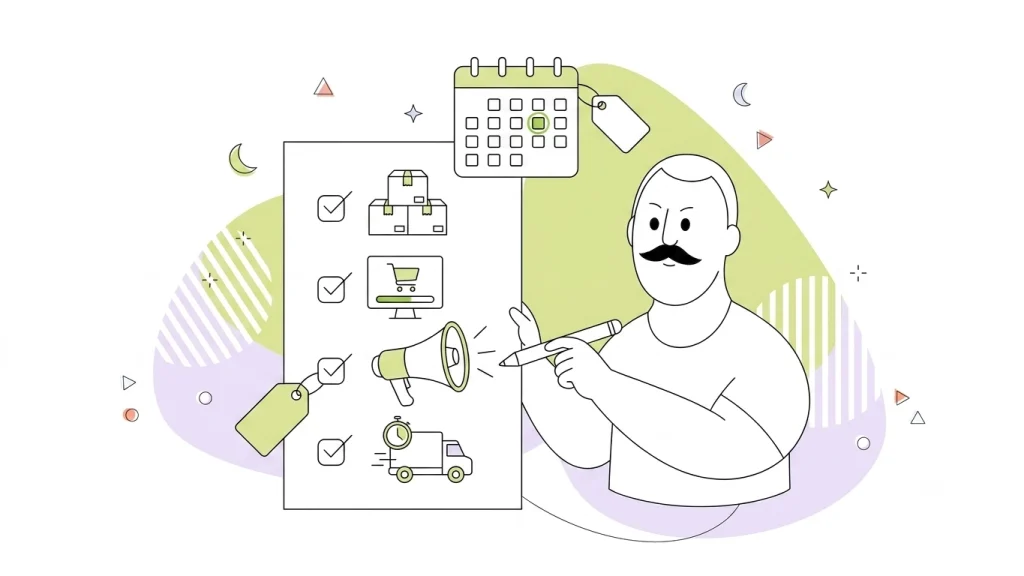
Here’s a six-week runway you can start this month. Treat it as your Black Friday checklist: each week has one job, each job builds on the one before it, and by the first week of November the only thing left to do is press send.
Why Black Friday Prep Starts in September
Every piece of a Black Friday promotion depends on another piece. Your email copy depends on the offer. Your landing page depends on the copy. Your shipping deadlines depend on your carrier’s holiday schedule, which you can’t control. Guess at the first decision, and you’ll rewrite the last three.
Six weeks also gives your suppliers, payment processor, and carriers time to respond. Those answers take days, and they don’t arrive faster because you’re in a hurry.
Week 1 (September 21 to 27): Decide the Offer
Pick one offer and write it in a single sentence. If you can’t say it in one sentence, your customers won’t understand it either.
Try it out loud: 25% off everything, no code needed. Buy two, get the third free. Take $50 off any booking over $200. Clear beats clever, every time.
Then answer these five questions and write the answers down somewhere your whole team can see them:
- What’s included, and what’s excluded
- Start and end dates, with times and a time zone
- Stacking rules for existing coupons, gift cards, and loyalty points
- Your margin at that discount, after shipping and payment fees
- One backup offer, in case a supplier lets you down
That fourth point is the one businesses skip. A 40% discount on a product with a 35% margin is a great sale and a bad month. Do the arithmetic now, while changing your mind costs you nothing.
Then lock it. Everything in weeks 2 through 6 is built on this decision, and every change you make later costs you a rewrite somewhere else.
Week 2 (September 28 to October 4): Confirm Payments & Inventory
Now that you know what you’re selling, you can work out what it takes to deliver it.
Inventory. Order your stock and ask suppliers for firm lead times in writing. Then pad those dates, because a supplier’s two weeks in October is often three weeks in November. If you sell services instead of products, ask the same question about capacity: how many bookings can your team actually deliver in December without falling over?
Payments. Sign in to your payment processor and check three things. Your monthly processing limit, because one big weekend can trip a cap you’ve never come close to. Your payout schedule over the holidays. Any account verification step you still haven’t finished. A held payout in December isn’t an inconvenience, it’s a cash flow problem.
Then place a real test order. Buy something from your own store with a real card, at full price and at the discount, and refund it afterwards. You’ll find the broken shipping rule or the out-of-date tax setting now, instead of on the 27th.
Week 3 (October 5 to 11): Build the Landing Page Early
Build your Black Friday landing page six weeks out and leave it unpublished, or publish it with a short “coming soon” note and an email signup form. Both approaches work. Building it on November 26 does not.
An early build buys you three things: time to fix the page speed problem you find, time to get a second pair of eyes on the copy, and a live URL you can drop into every email, ad, and social post without changing it later.
Keep the page simple:
- One offer, stated above the fold
- One button, repeated as the page scrolls
- Real product photos, compressed and saved as WEBP
- The end date, visible without scrolling
- Shipping and return terms, or a clear link to them
- A short FAQ answering the five questions you get asked most
Then open the page on an actual phone, not a narrow browser window on your laptop. Most of your Black Friday traffic will arrive on a phone, and a button that’s easy to tap is worth more than a clever headline. If you’re building with our Website Builder, start from a template rather than a blank canvas.
One last step: set up your tracking. On November 28, you’ll want to know which email, ad, or post actually drove sales.
Week 4 (October 12 to 18): Warm the Email List
Your email list is the cheapest channel you have on Black Friday, and it’s also the one most likely to let you down. Send a big campaign to a list that hasn’t heard from you since spring, and mailbox providers read that sudden spike as suspicious. Your best email of the year quietly lands in spam.
Warming a list means sending regular, useful, non-promotional email between now and November, so your Black Friday sends look like normal behaviour from a sender people recognize. You can’t cram that into the last week, which is why your Black Friday email marketing starts now.
Four things to do this week:
- Clean the list. Remove hard bounces and anyone who hasn’t opened an email in a year. A smaller list that engages beats a big list that doesn’t.
- Send something useful, with no discount in it. A short guide, a restock note, or a behind-the-scenes update all work.
- Segment into three groups: past customers, engaged subscribers, and everyone else. Past customers get your early access email.
- Write the full Black Friday sequence now, while you have time to write it well. Early access, launch morning, midpoint reminder, and last call.
While you’re in there, confirm your email authentication. SPF and DKIM are two settings in your domain’s DNS records that tell mailbox providers your email really comes from you, and missing them sends more of your campaign to spam. If you use our Business Email, these are already set up, and our PapaSquad team can confirm it for you in a couple of minutes.
Week 5 (October 19 to 25): Set Shipping & Booking Cutoffs
Your holiday shipping cutoffs start with your carrier, and carriers publish their holiday deadlines in October. Look yours up, then work backwards:
- Collect the cutoff dates for standard, expedited, and international shipping.
- Subtract your own handling time, honestly. One-day handling becomes three days on a 400-order weekend.
- Publish the resulting order-by dates on your product pages, in the cart, on the landing page, and in every email.
- Decide your exception rule now, so nobody has to invent an answer for the customer who orders two days late.
Service businesses need cutoffs too. Set the last date you’ll book December work, the last date a gift certificate can be redeemed for a December appointment, and the days your team is closed. Put all three on your booking page.
Clear deadlines do double duty here. They protect your team from promises it can’t keep, and they give shoppers a reason to buy today instead of next week.
Week 6 (October 26 to November 1): Plan Support Coverage
Support volume climbs during a sale, but the questions are predictable. Where’s my order, does the discount apply to this, can I change my address, when will it arrive, and can I get the sale price on something I bought last week.
- Write your answers to the 10 most likely questions and save them as reply templates.
- Put the same answers on the landing page, so most people never need to ask.
- Schedule the shifts. Name who covers Friday, Saturday, Sunday, and Cyber Monday, and in what hours.
- Set an autoresponder with a real response time, such as: we reply within four hours, 9:00 a.m. to 9:00 p.m. Eastern.
- Agree your refund and price-adjustment rules in advance, then share them with everyone answering messages.
Our guide to holiday support staffing goes deeper on staffing and training if you want a fuller picture.
We take this part seriously ourselves. Our PapaSquad experts cover phone, chat, and email 24/7, weekends and holidays included, because the busiest weekend of the year is exactly when nobody wants to wait in a queue.
November: Rehearse, Then Execute
If you’ve done the six weeks, November holds three tasks and no decisions.
In the first week, run a dress rehearsal. Place a test order at the discounted price, send the first email in your sequence to yourself and two colleagues, and click every link on the landing page. Fix what breaks.
In the second and third weeks, send your warm-up emails and confirm your stock arrived. Then, on the 27th, publish the page, send the campaign, and spend the day answering customers instead of building things.
Your Six-Week Guide at a Glance
| Week | Dates | The One Job | Done When |
|---|---|---|---|
| 1 | September 21 to 27 | Decide the offer | The offer fits in one sentence, and you know your margin |
| 2 | September 28 to October 4 | Confirm payments & inventory | Stock is ordered, and a test order went through cleanly |
| 3 | October 5 to 11 | Build the landing page | The page is finished, mobile-tested, and waiting at a live URL |
| 4 | October 12 to 18 | Warm the email list | The list is clean, segmented, and the sequence is written |
| 5 | October 19 to 25 | Set shipping & booking cutoffs | Order-by dates are published everywhere you sell |
| 6 | October 26 to November 1 | Plan support coverage | Shifts are scheduled, and reply templates are saved |
Don’t Forget the Site Underneath It All
A locked offer and a clean email list won’t help you if your site slows to a crawl at 6:00 a.m. on the 27th. Traffic on Black Friday weekend arrives in short, sharp spikes, which is a different kind of load than your ordinary Tuesday.
Give yourself one October afternoon to check the site itself, and put a tested backup and a mobile checkout run at the top of that list. Our hosting plans include a global Content Delivery Network (CDN), which serves your pages from the server closest to each visitor, and every plan carries a 99.9% uptime guarantee.
We’ll walk through the full technical checklist in a companion piece shortly. For now, the six weeks above are the part that has to start today.
Frequently Asked Questions
When should a small business start preparing for Black Friday?
Six to eight weeks out, which means mid-September for a November 27 sale. Inventory orders, carrier deadlines, and email list warming all need weeks of lead time, and none of them speed up under pressure.
Do I need a separate landing page for Black Friday?
Yes, for most businesses. One page with one offer and one button converts better than a homepage banner, and it gives you a single URL to use across every email, ad, and post.
What if my offer isn’t ready in September?
Start with weeks 2 through 6 anyway. Inventory, payments, cutoffs, and support coverage barely change based on the size of your discount, so you can lock those in while the offer takes shape.
Finish your website by lunchtime.
AI that drafts your entire site in under a minute, a drag-and-drop editor, mobile-responsive templates, a free domain, free SSL, and business email included, from as low as $5.95 per month with a 30-day money-back guarantee.